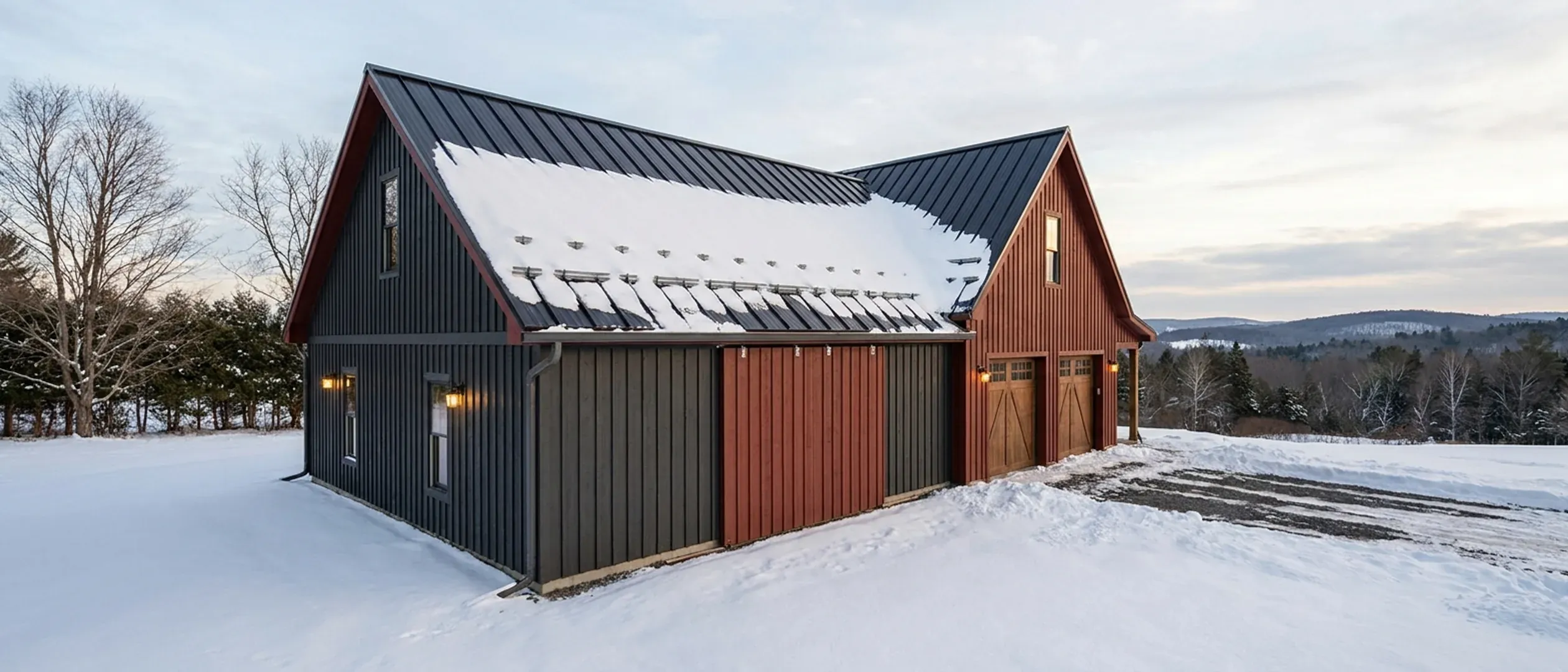
Are Barndominiums Legal in New York? Codes, Permits and Local Rules
Yes. New York has no rule against barndominiums. The law does not care whether a house has a steel frame, a pole barn frame or metal siding; it cares that a place where people live meets the building code, has a permit, and sits on land where the zoning allows a home. Outside New York City, every new house is built under the New York State Uniform Fire Prevention and Building Code, and for permit applications made since 31 December 2025 that means the 2025 Residential Code of New York State and the 2025 energy code. The permit comes from your city, town or village, or from the county or the Department of State where the local government has opted out of enforcing the code. What can stop a barndominium is local: zoning that does not allow the building or the shop on that parcel, or a site that cannot take a septic system, which your county health department reviews. This page sets out what the State decides, what it leaves to your municipality, and what to ask before you apply.
Figures on this page are cited third-party or government data, not a quote from New York Barndominium Builders.
Bottom Line Up Front
- Barndominiums are legal in New York. A barndominium is a house, and it is built under the same code as any other house where you build.
- Outside New York City, the Uniform Code applies statewide: permit applications made on or after 31 December 2025 follow the 2025 Residential Code of New York State. The permit comes from your city, town or village, or from the county or the Department of State where the municipality has opted out.
- Zoning is local, and so is most of what can stop a project. Check the zoning for the parcel before you buy, and confirm the current rule on gas and oil equipment with your building department before choosing a heating system.
What the State sets, and what it leaves to your municipality
The line between State and local rules explains most of what you will run into.
The State sets the building code
Outside New York City, the Uniform Code and the energy code are the State's, and the same editions apply everywhere. Your municipality enforces them.
The municipality issues the permit and inspects
Your city, town or village code enforcement office reviews the plans, issues the permit and inspects the work, unless it has opted out and the county or the Department of State does it instead.
Design values are applied to your site
New York sets ground snow loads by state map, adjusted for elevation, and each municipality fills in its own frost depth, so the frame and footings are designed for your exact site. There is no single New York figure for either.
Zoning is local
Whether the building is allowed, how far it sits from the lines, and whether the shop can be used for a business are all set by local zoning.
Plans, contracts and warranties
Three State laws shape the paperwork around a new home, whoever builds it.
Sealed plans for homes over 1,500 square feet
New York's Education Law bars building officials from accepting plans that are not stamped with the seal of a New York architect or professional engineer. The architecture article does not apply to residences of 1,500 square feet of gross area or less, not counting garages, carports, porches, cellars or uninhabitable basements and attics, so most barndominiums need sealed plans. We coordinate an independent design professional for you; see custom plans.
A written contract
The General Business Law treats a custom home built on land the buyer already owns, for the buyer to live in, as a home improvement for contract purposes. That means a written contract with start and completion dates, a description of the work and a payment schedule. Your contract is in writing, with payments tied to construction stages.
The implied warranty on a new home
New York's General Business Law gives buyers of a new home a housing merchant implied warranty: one year for workmanship, two years for the plumbing, electrical, heating, cooling and ventilation systems, and six years for material defects. A builder can replace it only with a written limited warranty that meets the law's standards.
No statewide contractor licence
New York has no statewide general contractor or home improvement licence. Some counties and cities have their own contractor rules, so ask your building department what applies where you build.
Septic, wells and special areas
Most rural barndominiums have their own septic system and well, and some land sits inside an area with its own approvals.
Septic systems: the county health department
Household septic systems are approved by your local health department, which the State Health Department's rules define as a city, county or part-county health department or a State Health Department district office. The system is designed by a New York design professional to the State's Appendix 75-A standards, which are minimums: local health departments and the Adirondack Park Agency may set stricter ones. We do not design or install septic systems; we build around the approved design.
The New York City water-supply watershed
Where a septic system will be on the watershed of a stream or reservoir that supplies New York City's water, Appendix 75-A requires the approval of the New York City Department of Environmental Protection as well as the local health department.
Shop drains are not household sewage
Appendix 75-A covers household sewage without industrial wastes. Floor drains in a shop that could carry oil, fuel or chemicals are not household sewage, so plan them separately with your health department.
Wells
Water wells in New York are drilled by a driller holding a certificate of registration from the Department of Environmental Conservation, to the Health Department's construction standard for drinking-water wells, and the driller must give you a copy of the well completion report.
Inside the Adirondack Park
Some activities inside the Adirondack Park need a permit from the Adirondack Park Agency; not every lot does. The Agency's advice is to start with a Jurisdictional Inquiry Form. If a permit is needed, no clearing, grading, excavation or utility work can begin until it is issued. Single-family homes are minor projects, decided within 45 days of a complete application.
Freshwater wetlands
If the land contains or borders a state-regulated freshwater wetland, work there may need a permit from the Department of Environmental Conservation. We check before you buy or design.
Agricultural districts
If your land is in a county agricultural district and you farm it, the Agriculture and Markets Law limits how far local rules can restrict the farm operation itself. It does not exempt a house: your barndominium still needs a building permit and must meet the zoning for a home.
New York City and the dense suburbs
New York City has its own code
New York City builds under its own construction codes, not the State's Uniform Code, and its land and zoning make a barndominium impractical in the five boroughs.
Long Island, Westchester and Rockland
The Uniform Code applies there, but lot sizes and local zoning make a barndominium difficult on many parcels. Rural land is where a barndominium fits.
What to ask before you apply
Who issues building permits here?
The city, town or village, or the county or the Department of State if the municipality has opted out.
What does the zoning allow on this parcel?
Ask about the house, the shop, any home business, setbacks, height and any design standards for metal buildings.
What design values apply to this site?
Ask the building department for the frost depth and other local design values it uses.
What is the current rule on gas and oil equipment?
Confirm it before choosing the heating system, water heater and range.
What needs approval besides the building permit?
The septic system goes to the county health department, the well is drilled by a driller holding a Department of Environmental Conservation certificate, and land inside the Adirondack Park, the New York City water-supply watershed or near a regulated wetland can need another agency's approval. Ask early which apply to the parcel.
Reading this because you are weighing a build? The next step is a plan drawn for your program.
What's different about New York
One building code outside New York City
The New York State Uniform Fire Prevention and Building Code applies everywhere in the state except New York City, which keeps its own building code under Executive Law section 383. The Department of State's notice of adoption says building permit applications submitted on or after 31 December 2025 must comply with the 2025 Uniform Code, which includes the 2025 Residential Code of New York State. That code is based on the 2024 International Residential Code and covers detached one-family homes up to three stories above grade plane, along with their accessory structures.
Who issues the permit
Under Executive Law section 381, every local government administers and enforces the Uniform Code, so the permit normally comes from the code enforcement office of your city, town or village. A local government may opt out by local law, in which case the county enforces the code there; if the county has opted out too, the Department of State enforces it directly or by contract. Ask the municipality where the land is who handles building permits.
A barndominium is not an agricultural building
The Uniform Code excuses agricultural buildings used directly and solely for agricultural purposes from its construction requirements. But the regulations define an agricultural building as a structure that shall not be a place of human habitation. A barndominium is a home, so it is always built to the residential code, even on a working farm. A separate barn used only for farm purposes is a different matter.
The 2025 energy code applies from day one
The Department of State's notice says the 2025 Energy Conservation Construction Code of New York State took effect on 31 December 2025 with no transition period, so permit applications from that date must comply. For a barndominium this governs the insulation, air sealing, windows and mechanical systems. Your designer works to the edition in force when the application is submitted.
Gas and oil equipment in new homes: check the current rule
New York law directs the building code to prohibit fossil-fuel equipment and building systems in most new buildings of seven stories or fewer, for permit applications from 31 December 2025. As of the Department of State's update of 2 July 2026, enforcement of those provisions is suspended by court order while litigation continues, and the Department says they are neither effective nor enforceable for now. A federal appeals court ruled for the State on 30 June 2026, so the position could change. We confirm the current rule with your building department before specifying a furnace, water heater or range; a heat-pump design works under either outcome.
Zoning is set locally
The Uniform Code decides how a house is built, not where. Whether a barndominium, a large shop or a home business is allowed on a parcel is decided by the zoning of the city, town or village, and the rules differ from one municipality to the next. Some regulate building appearance or the size of accessory buildings, so ask before you design.
Pros and cons, honestly
Pros
- No New York rule against barndominiums
- One building code everywhere outside New York City
- A clear chain for who enforces it: municipality, then county, then the Department of State
- Snow load and frost depth are worked out for your site, not taken from one statewide number
Cons
- Zoning differs from one municipality to the next
- A barndominium is never exempt as an agricultural building
- The rule on gas and oil equipment in new homes is in flux
- The 2025 codes apply to every application from 31 December 2025
- Dense suburbs and New York City rarely suit one
- Homes over 1,500 square feet of gross area need plans sealed by a New York architect or professional engineer
Are barndominiums legal in New York?
What building code applies to a barndominium in New York?
Who issues the building permit for a barndominium in New York?
Is a barndominium on a farm exempt from the building code?
Do barndominium plans need an architect's or engineer's stamp in New York?
Can I put a gas furnace or propane appliances in a new barndominium in New York?
Who approves a septic system for a barndominium in New York?
Can I build a barndominium in the Adirondacks?
Can I build a barndominium in New York City?
Does zoning allow barndominiums in my town?
Do I need a permit for a barndominium shop or garage?
Is there a warranty on a new barndominium in New York?
Does agricultural district land let me skip zoning or permits?
Questions answered? Tell us what you want to build and we will put real numbers against it.
Sources
- New York Department of State — Notice of Adoption, 2025 Uniform Code and Energy Code (with 2 July 2026 update on the court ruling)
- New York Department of State — Uniform Code amended rule text, December 2025 (19 NYCRR Parts 1219, 1220)
- New York Department of State — Assessment of Public Comments, Uniform Code (September 2025)
- New York Department of State — Building Standards and Codes
- New York Executive Law section 381 — administration and enforcement of the Uniform Code
- New York Executive Law section 383 — local codes in cities over one million
- New York Energy Law section 11-104 — energy code, fossil-fuel equipment in new buildings
- ICC Digital Codes — 2025 Residential Code of New York State
- New York Education Law section 7307 — architecture: seal on plans, exemption for small residences
- New York Education Law section 7209 — engineering: seal on plans
- New York General Business Law section 770 — home improvement and custom home definitions
- New York General Business Law section 771 — home improvement contract requirements
- New York General Business Law section 777-a — housing merchant implied warranty
- New York State Department of Health — 10 NYCRR Appendix 75-A, Wastewater Treatment Standards: Individual Household Systems (PDF)
- New York State Department of Health — 10 NYCRR Part 5, Appendix 5-B, Standards for Water Wells
- New York Environmental Conservation Law section 15-1525 — water well drillers
- Adirondack Park Agency — Permitting Overview
- New York Environmental Conservation Law section 24-0107 — freshwater wetlands definitions
- New York Agriculture and Markets Law section 305-a — local laws in agricultural districts
Keep reading
The pages that answer the next question this one raises.
Permitting
How the permit, septic and inspection steps fit into a build.
Read itBarndominium build timeline
The stages in order and what each one waits on.
Read itBarndominium pros and cons
Snow, heating and resale in New York.
Read itSite preparation
Clearing, grading, driveways and utility trenches.
Read itService areas
Local permit and land notes by city and county.
Read itStart the survey
Tell us where your land is.
Read itWant a real number instead of a range?
Start the survey and tell us about your land and what you want to build. Include the city, town or village and the parcel ID if you have them, because in New York the municipality, the soil and the well and septic answers change the budget more than the building does. The survey costs nothing.