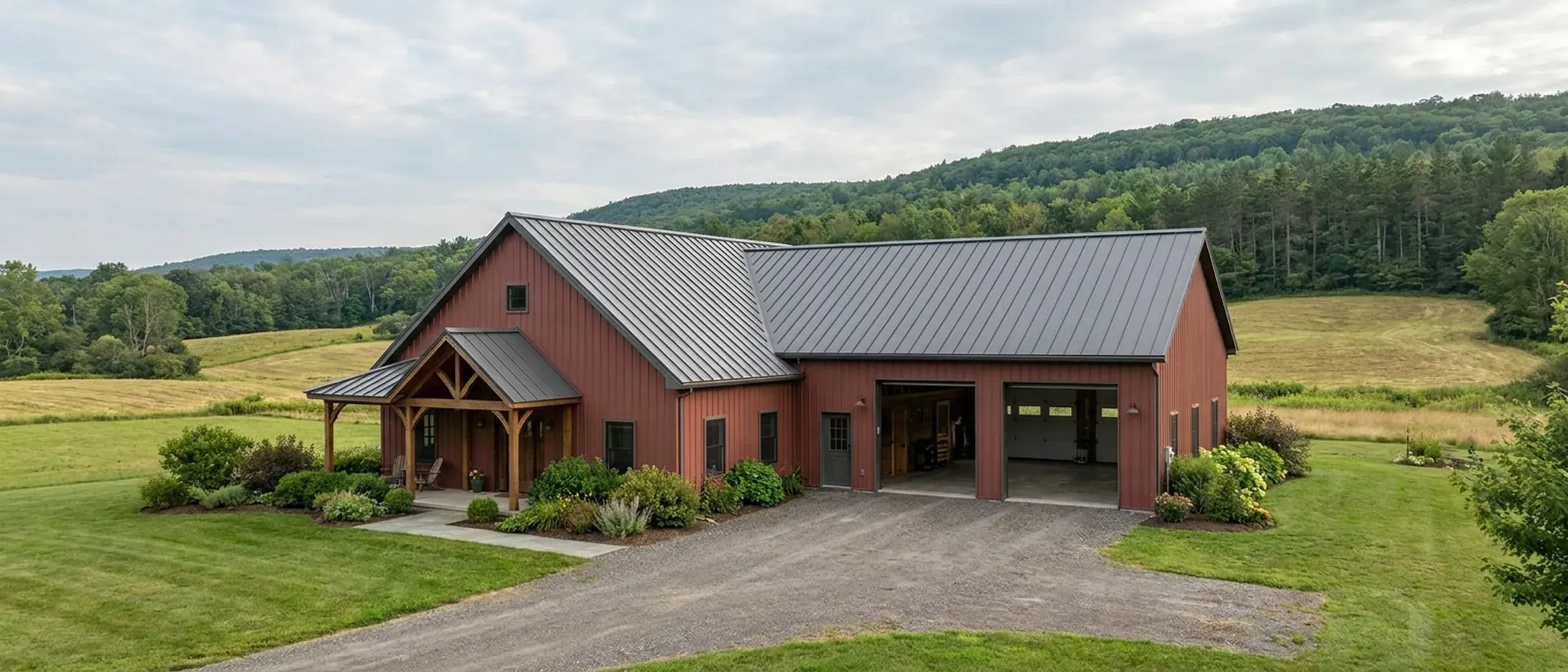
Barndominium Financing in New York: Construction Loans, Farm Credit, USDA and SONYMA
A barndominium is financed like any other new house that does not exist yet: with a construction loan that pays the builder in stages and then becomes a mortgage when the house is finished. What makes it harder in New York is the same thing that makes it harder anywhere: an appraiser has to value a steel or pole-barn home against nearby sales, and on a rural parcel the septic, well and driveway belong in the loan too. This guide covers the four routes New York buyers actually have. Fannie Mae's single-closing construction-to-permanent rules set how most lender construction loans work. Farm Credit East lends on rural homes and new home construction. USDA Rural Development can finance building a modest home in areas it designates as rural. And the State of New York Mortgage Agency (SONYMA) offers below-market fixed-rate mortgages for first-time buyers, with limits worth knowing before you count on it for a new build.
Figures on this page are cited third-party or government data, not a quote from New York Barndominium Builders.
Bottom Line Up Front
- A single-closing construction-to-permanent loan converts to a regular mortgage when the house is finished. Under Fannie Mae's Selling Guide (dated 6 May 2026), the construction period can run 18 months at most, and land you already own counts toward the loan-to-value calculation at its appraised value.
- Farm Credit East's Country Living loans cover new home construction, rural home lots and homes with acreage or farm buildings. USDA Rural Development can fund building a modest home in areas it designates as rural; check the address on USDA's eligibility map first.
- SONYMA's program pages describe fixed-rate loans for first-time buyers purchasing a home, through participating lenders. On 26 September 2026 its site showed 6.500% for the Low Interest Rate Program and 6.100% for Achieving the Dream; Freddie Mac's weekly 30-year average was 7.03% on 24 September 2026.
What actually moves the number
Plans and a cost breakdown
A construction lender funds a house that does not exist yet, so it needs the plans, a detailed budget and a contract before it will approve the loan. On a barndominium that budget must include the foundation, insulation, systems, finishes, septic and well, not just the kit.
Land you already own
Under Fannie Mae's rules, if you own the lot when the first construction advance is made, the loan is treated as a refinance and the loan-to-value ratio is figured on the as-completed appraised value of the land and house together. Land owned free and clear works like a down payment.
Interest rates
Freddie Mac's weekly survey put the average 30-year fixed rate at 7.03% for the week of 24 September 2026, against 6.30% a year earlier (week of 25 September 2025). Construction loans can carry a different rate during the build; ask each lender for both figures, in writing and dated.
Draw inspections
The lender releases money in draws as stages are completed and inspected. Your city, town or village building inspections and the lender's draw inspections are separate, and both have to pass before the builder is paid for a stage.
Construction-to-permanent loans
Most lender financing for a new barndominium follows Fannie Mae's rules for single-closing construction-to-permanent loans (Selling Guide B5-3.1-02, dated 6 May 2026), because lenders want to be able to sell the finished mortgage.
One closing, automatic conversion
Fannie Mae describes a single-closing transaction as one where the borrower closes on the construction loan and the permanent financing at the same time. The lender manages payments to the builder, and the construction loan converts to a long-term mortgage when construction is complete.
Twelve months per period, eighteen at most
Under Fannie Mae's rules, no single construction period may exceed 12 months and the total may not exceed 18 months, and Fannie Mae says exceptions will not be granted. A New York build that stalls over winter has to finish inside that window, so schedule the foundation before the ground freezes.
If you already own the land
If you own the lot at the time of the first construction advance, Fannie Mae treats the loan as a limited cash-out refinance and divides the loan amount by the as-completed appraised value of the lot and house. Land you own outright acts as equity.
If you are buying the land with the loan
If you do not yet own the lot, the loan is a purchase, and Fannie Mae divides the loan amount by the lesser of the total cost (construction plus the lot price) or the as-completed appraised value. A low appraisal therefore reduces what you can borrow.
Farm Credit East
Farm Credit East is one of the two Farm Credit institutions the Farm Credit System lists for New York, and the one that offers home loans.
What its Country Living loans cover
Farm Credit East lists country homes, homes with acreage or features like barns, sheds and other farm buildings, rural home lots, new home construction and refinancing of rural properties. A barndominium on acreage sits squarely in that list.
Why a rural lender matters for a barndominium
Farm Credit East says country homes and urban homes are distinctly different in their financing needs. For a steel or pole-barn home on acreage, a lender that already finances rural property and farm buildings may find comparable sales more easily.
Buying the land first
Because Farm Credit East also lends on rural home lots, some buyers finance the land first and the house later. When the construction loan closes, land you already own counts as equity under the construction-to-permanent rules above.
What to bring
Expect to provide the plans, the builder's contract and cost breakdown, the septic approval from the county health department, and proof of a water source. A kit invoice alone is not enough to underwrite a house. When you build a custom home on land you own, New York's home improvement contract law requires a written contract with start and completion dates, a description of the work, a mechanic's-lien notice and a payment schedule tied to the work, which is also what a construction lender wants to see.
USDA Rural Development in upstate New York
USDA's single-family housing programs work in areas it designates as rural. Two federal rule sets apply: 7 CFR part 3550 for direct loans and 7 CFR part 3555 for guaranteed loans made by private lenders.
Section 502 direct loans
Under 7 CFR 3550.52, Section 502 funds may be used to buy, build, rehabilitate, improve or relocate an eligible dwelling for use as the borrower's permanent residence. Household income must fall within the area's low-income limit at approval, and if the house is being built, an adult in the household must be available to make inspections and authorize progress payments (7 CFR 3550.53).
A modest home, not an income property
The direct-loan rules require a dwelling that is modest for the area, not designed for income-producing purposes, and within the area loan limit (7 CFR 3550.57). A barndominium with a large commercial shop can fall outside that; a house with an ordinary garage or storage bay is a different case. Ask before you design.
Guaranteed loans through a lender
Under 7 CFR 3555.101, a USDA-guaranteed loan may be used for the construction or purchase of a new dwelling, and for site preparation including grading, foundation, walks and the driveway. The loan is made by a private lender and guaranteed by USDA.
Site rules that matter on acreage
Under 7 CFR 3555.201 the site must be in a USDA-designated rural area, typical in size for the area, and not income-producing; property used primarily for agriculture or commercial enterprise is ineligible. It needs all-weather road access and adequate water and wastewater systems, and a private well and septic can qualify if the lender finds them adequate and code-compliant.
SONYMA: what it covers and what to ask
The State of New York Mortgage Agency, part of New York State Homes and Community Renewal, offers fixed-rate mortgages and down payment help. Its program pages are written for buying a home, so for a new build the questions come before the contract.
Who qualifies
SONYMA says its programs help qualified first-time buyers, with income and purchase price limits that differ by program, property type and region. It asks applicants to contribute 1% of their own funds, and loans with less than 20% down need mortgage insurance. In a federally designated Target Area the first-time buyer rule does not apply.
Rates on 26 September 2026
SONYMA's current-rates page showed 6.500% for the Low Interest Rate Program and 6.100% for Achieving the Dream (both without down payment assistance), and 6.100% for its ENERGY STAR labelled homes rate, on 26 September 2026. SONYMA says rates are subject to change at any time.
Down payment help
SONYMA's Down Payment Assistance Loan is a 0% interest loan that can be added to any SONYMA mortgage to help cover the down payment, closing costs or mortgage insurance. SONYMA also lists an interest-free, deferred Repayable Second Lien.
The new-build question
SONYMA's program pages describe mortgages for buying a home through participating lenders, not construction loans. Before you rely on SONYMA for a barndominium, ask a participating lender whether it can serve as the permanent loan on a house built on your land, and whether an ENERGY STAR labelled new home would qualify for the lower rate.
Paying cash and mixing sources
Not every barndominium is financed by one loan from start to finish.
Cash is common in new construction
Census data shows 26% of contractor-built houses started in the Northeast in 2025 were paid for in cash, and 74% with a conventional loan. Some owners pay cash for the land or the shell and borrow for the rest.
Land loans first, construction loans later
Buying land with a lot loan and building later spreads the cost out. Under Fannie Mae's rules, owning the lot at the first construction advance makes it equity in the construction-to-permanent loan.
Rates move
Freddie Mac's weekly average 30-year fixed rate was 7.03% on 24 September 2026 and 6.30% on 25 September 2025. The 15-year average was 6.42% on 24 September 2026. Lock a rate only when the build schedule is settled.
Budget the site into the loan
The septic, the well, the driveway and power to the site are part of the house for lending purposes. USDA's guaranteed-loan rules explicitly allow site preparation, grading, foundation and the driveway as loan costs (7 CFR 3555.101).
Reading this because you are weighing a build? The next step is a plan drawn for your program.
What's different about New York
SONYMA is a first-time buyer lender
SONYMA says its programs are for qualified first-time buyers, with income and purchase price limits that vary by program, property type and region. In a federally designated Target Area you do not have to be a first-time buyer. SONYMA does not take applications itself; you apply through a participating lender.
Farm Credit East is the Farm Credit lender here
The Farm Credit System's New York page lists Farm Credit East and CoBank as the Farm Credit institutions in New York. Farm Credit East's Country Living loans cover country homes, homes with barns and other farm buildings, rural home lots and new home construction.
USDA eligibility is by address
USDA Rural Development guarantees and makes home loans only in areas it designates as rural. Eligibility is decided for the specific property, not for a whole county. Use USDA's eligibility map before you choose the loan.
Property tax goes into the payment
Many mortgages escrow property tax, and in New York that can be a large share of the monthly payment. The Tax Foundation's 2026 table of Census data shows median property taxes of $4,880 a year in Onondaga County and $10,000 or more in Suffolk and Nassau counties. Ask the town assessor for an estimate on the finished house before you size the loan.
Can you get a mortgage for a barndominium in New York?
What is a construction-to-permanent loan?
Does USDA finance barndominiums in New York?
Can I use SONYMA to build a barndominium?
Can my land count toward the down payment?
What are mortgage rates in New York right now?
Which Farm Credit lender serves New York?
Questions answered? Tell us what you want to build and we will put real numbers against it.
Sources
- Fannie Mae Selling Guide B5-3.1-02 — Conversion of Construction-to-Permanent Financing: Single-Closing Transactions (dated 05/06/2026) — Construction period 12 months per period, 18 total; LTV for purchase vs limited cash-out refinance. Read 26 Sep 2026.
- Farm Credit East — Country Living (Rural Home) Loans — Country homes, homes with farm buildings, rural home lots, new home construction. Read 26 Sep 2026.
- Farm Credit — New York — Farm Credit institutions in New York: CoBank, Farm Credit East. Read 26 Sep 2026.
- eCFR — 7 CFR 3550.52, Section 502 direct loans: loan purposes — Buy, build, rehabilitate, improve or relocate an eligible dwelling. Read 26 Sep 2026.
- eCFR — 7 CFR 3550.53 and 3550.57, Section 502 eligibility and dwelling requirements — Income limits, inspections during construction, modest dwelling. Read 26 Sep 2026.
- eCFR — 7 CFR 3555.101, USDA guaranteed loans: loan purposes — Construction or purchase of a new dwelling; site preparation. Read 26 Sep 2026.
- eCFR — 7 CFR 3555.201, USDA guaranteed loans: site requirements — Rural area, typical site size, not income-producing, water and wastewater. Read 26 Sep 2026.
- USDA — Property eligibility map (single-family housing) — Rural-area eligibility by address.
- New York State Homes and Community Renewal — State of New York Mortgage Agency (SONYMA) — Programs for first-time buyers; applications through participating lenders. Read 26 Sep 2026.
- SONYMA — Preparation & Eligibility — 1% own funds, income and price limits, Target Area rules. Read 26 Sep 2026.
- SONYMA — Current Rates — Rates as displayed 26 Sep 2026: Low Interest Rate 6.500%, Achieving the Dream 6.100% (without DPA).
- Freddie Mac — Primary Mortgage Market Survey, historical data — 30-year fixed 7.03% and 15-year 6.42% (week of 24 Sep 2026); 30-year 6.30% (week of 25 Sep 2025). Read 26 Sep 2026.
- U.S. Census Bureau — Contractor-Built Houses Started by Type of Financing (Characteristics of New Housing, 2025) — Northeast 2025: conventional 74%, cash 26%. Read 26 Sep 2026.
- Tax Foundation — Property Taxes by State and County, 2026 — County median property taxes (Census ACS 2024, 5-year). Read 26 Sep 2026.
Keep reading
The pages that answer the next question this one raises.
Cost to build a barndominium in New York
The published cost figures a lender will compare your budget against.
Read itHow big a barndominium your budget builds
Turning a loan amount into square footage after land and site costs.
Read itBarndominium build timeline
How long each stage takes, and why it matters for an 18-month construction loan.
Read itTurnkey builds
One contract for the whole house, which is what a construction lender wants to see.
Read itPermitting
The building permit and septic approval a lender asks for before the first draw.
Read itWant a real number instead of a range?
Start the survey and tell us about your land and what you want to build. Include the city, town or village and the parcel ID if you have them, because in New York the municipality, the soil and the well and septic answers change the budget more than the building does. The survey costs nothing.