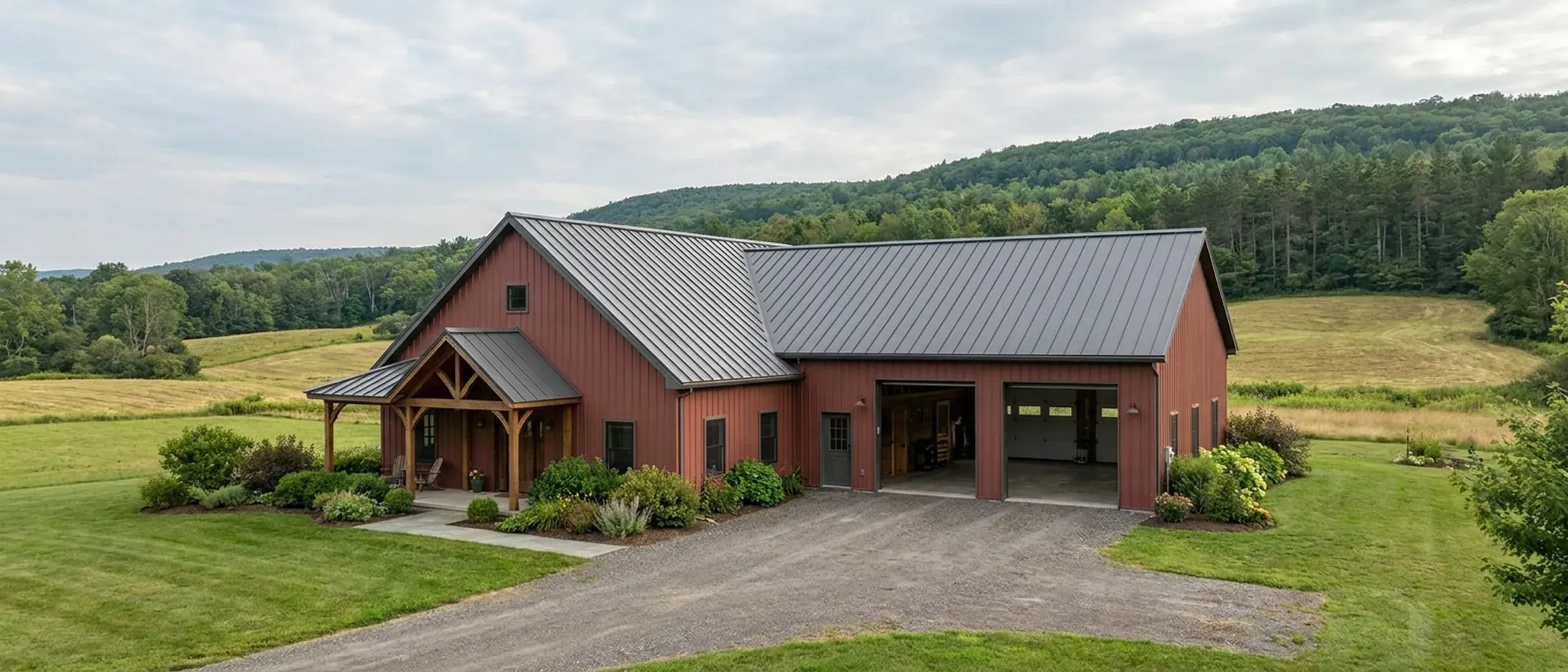
Cost to Build a Barndominium in New York
Nobody publishes a measured cost for building a barndominium in New York, and a page that hands you one statewide price per square foot is guessing. What does exist is better than a guess. The Census Bureau measures what owners in the Northeast pay a general contractor to build a house on land they already own. The Census building-permit survey records what New York builders declared for every new single-family home in 2025, county by county. USDA prices New York farmland every year, and the Bureau of Labor Statistics publishes what carpenters earn in Buffalo, Syracuse, Albany and the New York City metro area. This guide puts those numbers side by side, explains why the same barndominium costs very different money on Long Island and in the North Country, and shows the site costs (septic, well, snow and frost design, heat) that decide most New York budgets. None of these figures is a quote, and none of them is ours.
Figures below are industry data from cited third-party sources, not a quote from New York Barndominium Builders. Every project is priced individually.
Bottom Line Up Front
- The closest published benchmark is the Census Bureau's 2025 figure for contractor-built houses on the owner's own land in the Northeast region: a median contract price of $179.30 per square foot and an average of $246.26, with the land excluded.
- Census permit data shows the spread inside New York: builders declared an average of about $419,500 per new single-family home statewide in 2025, from about $846,800 in Suffolk County to about $171,100 in Oswego County.
- Land, septic, a well and the property tax bill move a New York budget as much as the building does. USDA puts the 2026 average New York farm real estate value at $4,500 an acre, and the Tax Foundation's county table shows median property taxes from under $3,000 to $10,000 or more a year.
Published cost figures
Third-party and government figures, each with its source. None of them is a quote, and none of them is ours.
| Measure | Range | Source |
|---|---|---|
| Contractor-built houses on the owner's land, Northeast region, started in 2025: median to average contract price (land excluded) | $179–$246 per sq ft | U.S. Census Bureau, Characteristics of New Housing 2025, Median and Average Contract Price per Square Foot of New Contractor-Built Single-Family Houses Started: Northeast median $179.30 (RSE 10%), average $246.26 (RSE 20%) (read 26 Sep 2026) — https://www.census.gov/construction/chars/xls/contractpricesqft_cust.xls |
| Detached new houses sold by builders, Northeast region, 2025: median to average sales price (lot excluded) | $233–$278 per sq ft | U.S. Census Bureau, Characteristics of New Housing 2025, Median and Average Price per Square Foot of Floor Area in Detached New Single-Family Houses Sold: Northeast median $232.57, average $277.66 (read 26 Sep 2026) — https://www.census.gov/construction/chars/xls/soldpricesqft_cust.xls |
| Average construction cost alone (no lot, overhead, marketing or profit), national builder survey, 2024 | $162 per sq ft | NAHB, Cost of Constructing a Home 2024 (Eric Lynch, 20 Jan 2025): average construction cost $428,215, about $162 per square foot, national only (read 26 Sep 2026) — https://www.nahb.org/-/media/NAHB/news-and-economics/docs/housing-economics-plus/special-studies/2025/special-study-cost-of-constructing-a-home-2024-january-2025.pdf |
| New single-family homes authorized in 2025, average permit valuation per home: Middle Atlantic division to New York State | $337,900–$419,500 per home | U.S. Census Bureau, Building Permits Survey, annual 2025 (stateannual_202599.xls): 1-unit valuation ÷ 1-unit homes. New York $4,824,353 thousand ÷ 11,499 = about $419,500; Middle Atlantic division $13,561,608 thousand ÷ 40,131 = about $337,900 (read 26 Sep 2026) — https://www.census.gov/construction/bps/xls/stateannual_202599.xls |
| New York agricultural land, 2026 state average: pasture to all farm real estate | $2,040–$4,500 per acre | USDA NASS, Land Values 2026 Summary (released 31 July 2026): New York pasture $2,040, cropland $4,150, farm real estate $4,500 per acre (read 26 Sep 2026) — https://www.nass.usda.gov/Publications/Todays_Reports/reports/land0726.pdf |
Total cost by size
Rough totals at common sizes. These move with everything on this page, so treat them as a starting orientation, not an estimate for your project.
1,500 sq ft
$269,000–$369,000
Arithmetic, rounded to the nearest $1,000: 1,500 sq ft × the Census 2025 Northeast contract price per sq ft for contractor-built houses ($179.30 median, $246.26 average), land excluded — https://www.census.gov/construction/chars/xls/contractpricesqft_cust.xls
2,000 sq ft
$359,000–$493,000
Arithmetic, rounded to the nearest $1,000: 2,000 sq ft × the Census 2025 Northeast contract price per sq ft for contractor-built houses ($179.30 median, $246.26 average), land excluded — https://www.census.gov/construction/chars/xls/contractpricesqft_cust.xls
2,400 sq ft
$430,000–$591,000
Arithmetic, rounded to the nearest $1,000: 2,400 sq ft (a 40x60 footprint, fully finished) × the Census 2025 Northeast contract price per sq ft for contractor-built houses ($179.30 median, $246.26 average), land excluded — https://www.census.gov/construction/chars/xls/contractpricesqft_cust.xls
3,000 sq ft
$538,000–$739,000
Arithmetic, rounded to the nearest $1,000: 3,000 sq ft × the Census 2025 Northeast contract price per sq ft for contractor-built houses ($179.30 median, $246.26 average), land excluded — https://www.census.gov/construction/chars/xls/contractpricesqft_cust.xls
What actually moves the number
The finish schedule, not the frame
NAHB's 2024 survey puts interior finishes at 24.1% of construction cost and the plumbing, electrical and HVAC rough-ins at another 19.2%. A barndominium needs the same cabinets, flooring, drywall and mechanical systems as any other house, so the finishes you choose move the total more than the steel or pole-barn shell does.
Which end of the state the land is in
The Census permit survey shows builders declaring about $846,800 per new home in Suffolk County in 2025 and about $171,100 in Oswego County. Part of that gap is the size and finish of what gets built, and part is labour: BLS puts the 2025 mean carpenter wage at $80,560 in the New York City metro area and $60,500 in the Watertown area.
Septic and a private well
Most rural New York land has no sewer main. Census data for contractor-built houses completed in the Northeast in 2025 shows 58% on an individual septic system and 49% on septic plus a private well. Both are budget lines a subdivision lot does not carry, and the county health department's process decides how much design work the septic needs.
Snow and frost design
New York's code sets the ground snow load for your site from a state map, and your local building department sets the frost depth your footings must reach. A roof designed for a heavy lake-effect or high-elevation snow load needs stronger trusses or purlins and closer spacing than the same building in a lighter zone, which shows up in the kit price.
How much does a barndominium cost?
Most cost-per-square-foot numbers online are national, unsourced, or describe tract houses on finished subdivision lots. The Census Bureau's contractor-built series avoids all three problems, which makes it the right starting point for a New York barndominium.
It measures the way a barndominium is usually bought
The Census contractor-built category is a house built by a general contractor on land the owner already holds. That is how most barndominiums are built: you own or buy the land, then contract for the building. The contract price excludes the value of the lot, so the figure is the building and its site work, not the land.
The Northeast figures for 2025
For houses started in 2025 in the Northeast region, the Census Bureau reports a median contract price of $179.30 per square foot and an average of $246.26. The Census median contract price for the whole house was $431,100. New York is in the Middle Atlantic division of the Northeast region, but this Census table is published by region only, so it cannot be narrowed to New York alone.
Treat the average with care
The Census Bureau publishes a relative standard error with each figure: 10% on the Northeast median and 20% on the Northeast average. The Northeast sample is small (about 17,000 contractor-built starts in 2025), and a small number of very expensive houses can pull the average up. The median is the steadier number for planning.
What the Census figure leaves out
The contract price does not include the land, and the Census figure covers conventional houses of every type, not barndominiums specifically. Framing data from the same survey shows 97% of contractor-built houses completed in the Northeast in 2025 were wood-framed. A steel or pole-barn shell changes the framing line of the budget; it does not change the finishes, the systems or the site work, which are most of the cost.
Barndominium cost per square foot, county by county
The Census Bureau's Building Permits Survey records the construction value builders declare on every permit for a new single-family home. It is published by state and by county, which is the closest thing to a New York cost map that exists.
The statewide number
In 2025 New York permit offices authorized 11,499 new single-family homes with a declared value of $4.82 billion, which is about $419,500 per home. The Census figure for the whole Middle Atlantic division is about $337,900 per home, and the national figure is about $320,800.
The downstate counties
Divided the same way, the 2025 county data gives about $846,800 per new home in Suffolk County, $713,900 in Westchester County, $617,900 in Nassau County, $543,900 in Rockland County and $537,000 in Dutchess County. Those counties sit at the top of the state.
The upstate metros
The same arithmetic gives about $464,600 per new home in Erie County, $413,900 in Saratoga County, $408,600 in Onondaga County, $401,100 in Monroe County and $350,400 in Albany County.
The rural counties
In the rural counties the declared value falls further: about $216,700 per new home in Steuben County, $206,200 in St. Lawrence County, $174,800 in Jefferson County and $171,100 in Oswego County. A permit valuation is what the applicant declares for the structure, not an audited cost, and a county's figure moves with the size and finish of what happened to be built that year. Read it as a map of where money is spent, not as a price.
Upstate vs downstate: what labour and land cost
The same barndominium drawings cost different money in different parts of New York because two inputs change: the wages of the people who build it and the price of the ground it sits on.
Carpenter wages by metro area
The Bureau of Labor Statistics' May 2025 wage estimates put the mean annual wage for carpenters at $80,560 in the New York City metro area, $66,520 in the Albany area, $65,290 in the Syracuse area, $64,630 in the Buffalo area, $62,720 in the Rochester area and $60,500 in the Watertown area. The BLS statewide mean is $75,970. Downstate labour runs about a third higher than the North Country for the same trade.
The other trades follow the same line
BLS reports the May 2025 mean electrician wage at $88,670 in the New York City metro area against $75,440 in the Buffalo area, and construction labourers at $67,440 against $57,970. Labour is a large share of every stage of a build, so the wage gap carries through the whole budget.
What USDA says a New York acre is worth
USDA's Land Values 2026 Summary puts New York farm real estate at $4,500 an acre in 2026, up 4.7% on 2025. USDA puts cropland at $4,150 an acre and pasture at $2,040. USDA puts the Northeast region as a whole at $7,510 an acre, so New York farmland sits well below the Northeast regional average.
Agricultural value is not lot value
USDA's figures describe farmland across the state. A five-acre parcel with road frontage, a perc-tested building site and power at the road sells for more per acre than a large farm, and land within reach of New York City trades at residential prices. Use the USDA number to sanity-check a rural parcel, not to price a lot in the Hudson Valley or on Long Island.
Where the money in a house actually goes
NAHB's 2024 Cost of Constructing a Home survey breaks the average single-family build into stages. It is national (NAHB says the sample is too small for a regional breakdown), but the proportions show where a barndominium saves money and where it does not.
Framing and exterior are about 30%
Framing (including the roof structure) is 16.6% of construction cost in the NAHB survey and exterior finishes another 13.4%. These are the stages a steel or pole-barn shell changes. Even a large saving on the shell moves only part of the total.
Systems and finishes are over 43%
Major systems rough-ins (plumbing 6.3%, electrical 6.4%, HVAC 6.3%) total 19.2%, and interior finishes (insulation, drywall, cabinets, flooring, fixtures) total 24.1%. A barndominium needs every one of these, so they cost about what they cost in any New York house of the same size and finish.
Foundations are about 10%
Excavation, foundation, concrete and backfill are 10.5% of construction cost nationally. In New York your footings must reach the frost depth your local building department sets, and that depth is set locally, not statewide. Ask for it before the foundation is priced.
Site work and fees are about 8%
Permit fees, impact fees, water and sewer fees and design fees together are 7.6% of construction cost in the NAHB survey. On a rural New York parcel the water and sewer line becomes a private well and a septic system instead, and the design fee includes whatever the county health department requires for the septic.
The New York site costs to price before the building
The biggest surprises in a New York barndominium budget are usually underground or overhead: the septic system, the well, the frost-depth foundation and the snow load on the roof. None of them has a statewide price, so these are the questions to answer for your own parcel.
Septic: the county health department decides the process
Septic systems for homes are approved by your county health department (or a State Health Department district office) and built to the state's Appendix 75-A standards; inside the New York City watershed, the city's Department of Environmental Protection must also approve. Counties run the process differently: Cattaraugus County's Environmental Health Division says its own inspector evaluates the soil and designs the residential system before issuing a permit to construct, while Monroe County's Department of Public Health reviews submitted plans and witnesses the percolation tests. Ask your county how its process works before you price the design.
The well
Census data shows about half of the contractor-built houses completed in the Northeast in 2025 were on septic plus a private well. Drilling cost depends on depth to water, and depth varies parcel by parcel, so get neighbouring well depths and a driller's quote before you settle the building budget. Wells are drilled by a DEC-registered water well driller to the Health Department's construction standard, and the driller gives you a copy of the well completion report.
Snow load on the roof
New York's code sets ground snow load from a state map applied site by site, with higher elevations adding to it. The map value changes across the state and climbs with elevation, so two parcels in the same county can carry different loads. Give your kit supplier the exact site address so the trusses and purlins are designed for it, and compare kit quotes only when they are engineered to the same load.
Heat and fuel
Whether the house can have a gas or propane furnace depends on the all-electric rule, which the Department of State's July 2026 notice says is suspended by court order. Price a heat-pump system either way, because a design that assumes a fuel the rule later excludes has to be redrawn.
Reading this because you are weighing a build? The next step is a plan drawn for your program.
What's different about New York
One building code everywhere except New York City
The 2025 Residential Code of New York State applies to building permit applications submitted on or after 31 December 2025. New York City has its own building code; the New York State Uniform Code applies everywhere else in the state. A barndominium is designed, permitted and inspected as a house, not as a farm building.
Your city, town or village issues the permit
In New York the building permit comes from the city, town or village where the land sits. If that municipality has opted out of enforcing the code, the county enforces it, and if the county has also opted out, the Department of State does. Permit fees are set locally, so budget for your own municipality's fee schedule rather than a statewide number. See the legal guide for the rules in full.
The all-electric rule is written but not in force
New York law directs the building code to prohibit fossil-fuel heating and appliances in most new low-rise buildings. As of the Department of State's July 2026 notice, enforcement of that rule is suspended by court order while litigation continues, so confirm the current rule with your building department before you price a furnace, water heater or range. A heat-pump design is a safe choice either way.
Property tax is part of the cost of building
The Tax Foundation's 2026 table of Census data puts New York's effective property tax rate at 1.30% of home value in 2024. The county medians run from $2,440 a year in Franklin County to $10,000 or more (the top of the Census scale) in Nassau, Suffolk, Westchester and Rockland counties. A new barndominium is assessed like any other new house, so the finished value you build is the value the assessor taxes.
Land prices split the state in two
USDA's 2026 survey puts New York farm real estate at $4,500 an acre on average, cropland at $4,150 and pasture at $2,040. Those are statewide averages of agricultural land; a buildable lot with road frontage near a metro area sells for more, and land in the downstate counties trades at residential prices rather than farm prices.
How much does it cost to build a barndominium in New York?
How much would a 2,000 sq ft barndominium cost to build?
How big of a barndominium can I build for $200,000?
Can I build a barndominium for $100,000 in New York?
Is it cheaper to build upstate than downstate?
Do I have to build an all-electric barndominium in New York?
How much are property taxes on a new barndominium in New York?
Why don't you publish your own prices?
Questions answered? Tell us what you want to build and we will put real numbers against it.
Sources
- U.S. Census Bureau — Median and Average Contract Price per Square Foot of New Contractor-Built Single-Family Houses Started (Characteristics of New Housing, 2025) — Northeast 2025: median $179.30 (RSE 10%), average $246.26 (RSE 20%) per sq ft, lot excluded. Read 26 Sep 2026.
- U.S. Census Bureau — Median and Average Contract Price of New Contractor-Built Single-Family Houses Started — Northeast 2025: median $431,100, average $745,900. Read 26 Sep 2026.
- U.S. Census Bureau — Price per Square Foot of Floor Area in Detached New Single-Family Houses Sold — Northeast 2025: median $232.57, average $277.66, lot excluded. Read 26 Sep 2026.
- U.S. Census Bureau — Type of Sewage System and Water Supply, and Type of Framing, New Single-Family Houses Completed — Northeast contractor-built 2025: 58% individual septic, 49% septic plus individual well; framing table (framing_cust.xls): 97% wood. Read 26 Sep 2026.
- U.S. Census Bureau — Building Permits Survey, annual 2025, units and valuation by state and division — New York 1-unit: 11,499 homes, $4,824,353 thousand. Read 26 Sep 2026.
- U.S. Census Bureau — Building Permits Survey, annual 2025, by county — New York counties, 1-unit homes and valuation; per-home figures are arithmetic. Read 26 Sep 2026.
- NAHB — Cost of Constructing a Home 2024 (Eric Lynch, 20 January 2025) — Table 1 construction cost breakdown; national averages only. Read 26 Sep 2026.
- USDA National Agricultural Statistics Service — Land Values 2026 Summary — New York 2026: farm real estate $4,500, cropland $4,150, pasture $2,040 per acre. Read 26 Sep 2026.
- U.S. Bureau of Labor Statistics — Occupational Employment and Wage Statistics, May 2025 metropolitan area estimates — Mean annual wages for carpenters (47-2031), electricians (47-2111) and construction laborers (47-2061) by New York metro area, via the BLS public data API. Read 26 Sep 2026.
- Tax Foundation — Property Taxes by State and County, 2026 (Census American Community Survey data) — Table 1 county medians (2024, 5-year) and Table 2 state effective rates (New York 1.30%, 2024). Read 26 Sep 2026.
- Cattaraugus County — Onsite Wastewater Treatment Systems — Permit process; the county inspector designs the residential system. Read 26 Sep 2026.
- Monroe County Department of Public Health — Onsite Wastewater Treatment Systems — Plan review and field-test witnessing under the Monroe County Sanitary Code. Read 26 Sep 2026.
Keep reading
The pages that answer the next question this one raises.
Barndominium vs. house cost
The same NAHB cost stages compared for a steel or pole-barn shell and a conventionally framed house, against what existing New York homes list for.
Read itHow big a barndominium your budget builds
Working backward from a budget to square footage, after land, septic and well come off the top.
Read itBarndominium financing in New York
Construction-to-permanent loans, Farm Credit East, USDA Rural Development and SONYMA.
Read itBarndominium laws in New York
The Uniform Code, who issues the permit, and the rules New York City keeps for itself.
Read itBarndominium kits
What a kit includes, and why kit quotes must be engineered to the same snow load before you compare them.
Read itSite preparation
Pad, driveway, utilities, septic and well: the ground work that happens before the building exists.
Read it40x60 barndominium floor plans
The 2,400-square-foot footprint used in the cost table above.
Read itWant a real number instead of a range?
Start the survey and tell us about your land and what you want to build. Include the city, town or village and the parcel ID if you have them, because in New York the municipality, the soil and the well and septic answers change the budget more than the building does. The survey costs nothing.