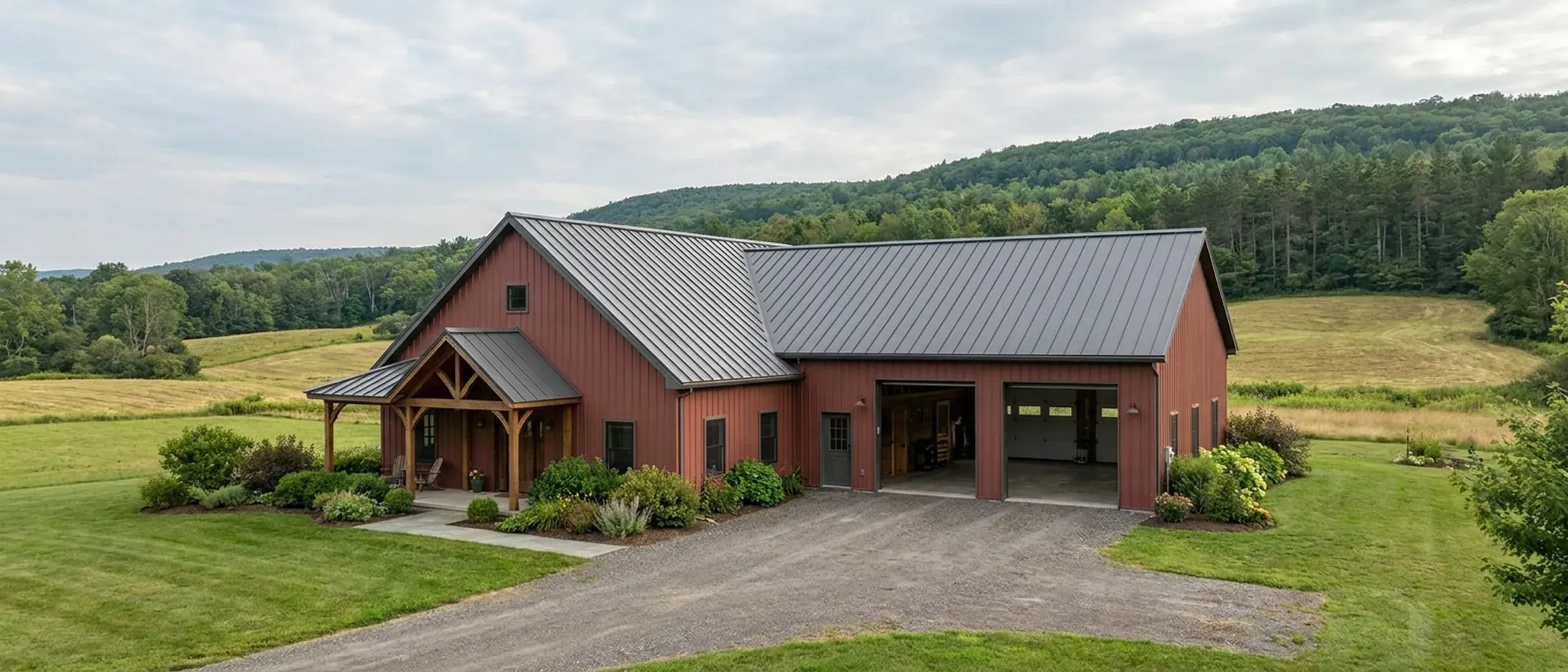
How Big a Barndominium Can You Build in New York on Your Budget?
The question most people ask first (how much per square foot?) is the wrong way round. A New York barndominium budget has to pay for the ground before it pays for the building: the land, the driveway, power to the site, and in most rural places a septic system and a private well. What is left after those is the building budget, and only then does a cost per square foot turn it into a size. This guide does that arithmetic with published numbers. The divisor is the Census Bureau's 2025 contract price for contractor-built houses on the owner's land in the Northeast, a median of $179.30 per square foot and an average of $246.26, land excluded. The ground costs are yours to price, and the guide shows where each one comes from.
Figures below are industry data from cited third-party sources, not a quote from New York Barndominium Builders. Every project is priced individually.
Bottom Line Up Front
- Take the land and site costs off the top first. Census data shows 58% of contractor-built houses completed in the Northeast in 2025 were on a septic system and 49% on septic plus a private well, so most rural New York budgets carry both.
- Divide what is left by the Census 2025 Northeast contract price: $179.30 per square foot at the median, $246.26 at the average. By that arithmetic, a $300,000 building budget buys about 1,670 square feet at the median and about 1,220 at the average.
- For comparison, Census reports the median contractor-built house completed in the Northeast in 2025 at 2,495 square feet. Shop and garage space under the same roof stretches a budget further than finished living space.
Published cost figures
Third-party and government figures, each with its source. None of them is a quote, and none of them is ours.
| Measure | Range | Source |
|---|---|---|
| Contractor-built houses on the owner's land, Northeast region, started in 2025: median to average contract price (land excluded) | $179–$246 per sq ft | U.S. Census Bureau, Characteristics of New Housing 2025, Median and Average Contract Price per Square Foot of New Contractor-Built Single-Family Houses Started: Northeast median $179.30, average $246.26 (read 26 Sep 2026) — https://www.census.gov/construction/chars/xls/contractpricesqft_cust.xls |
| New York agricultural land, 2026 state average: pasture to all farm real estate | $2,040–$4,500 per acre | USDA NASS, Land Values 2026 Summary (released 31 July 2026): New York pasture $2,040, farm real estate $4,500 per acre (read 26 Sep 2026) — https://www.nass.usda.gov/Publications/Todays_Reports/reports/land0726.pdf |
Total cost by size
Rough totals at common sizes. These move with everything on this page, so treat them as a starting orientation, not an estimate for your project.
1,000 sq ft
$179,000–$246,000
Arithmetic, rounded to the nearest $1,000: 1,000 sq ft × the Census 2025 Northeast contract price per sq ft for contractor-built houses ($179.30 median, $246.26 average), land excluded — https://www.census.gov/construction/chars/xls/contractpricesqft_cust.xls
1,500 sq ft
$269,000–$369,000
Arithmetic, rounded to the nearest $1,000: 1,500 sq ft × the Census 2025 Northeast contract price per sq ft for contractor-built houses ($179.30 median, $246.26 average), land excluded — https://www.census.gov/construction/chars/xls/contractpricesqft_cust.xls
2,000 sq ft
$359,000–$493,000
Arithmetic, rounded to the nearest $1,000: 2,000 sq ft × the Census 2025 Northeast contract price per sq ft for contractor-built houses ($179.30 median, $246.26 average), land excluded — https://www.census.gov/construction/chars/xls/contractpricesqft_cust.xls
2,500 sq ft
$448,000–$616,000
Arithmetic, rounded to the nearest $1,000: 2,500 sq ft × the Census 2025 Northeast contract price per sq ft for contractor-built houses ($179.30 median, $246.26 average), land excluded — https://www.census.gov/construction/chars/xls/contractpricesqft_cust.xls
What actually moves the number
Land first
USDA puts New York farm real estate at $4,500 an acre in 2026 and pasture at $2,040, as statewide averages. A buildable parcel with road frontage and a tested septic site usually prices above farmland, and anything within reach of New York City prices as residential land. Settle the land price before you size the house.
Septic and well
Census data shows most contractor-built houses completed in the Northeast in 2025 were on septic, and about half on septic plus a private well. The county health department's process decides how much design work the septic needs, and the well's depth decides the drilling cost. Get both priced for your parcel before you decide the size of the house.
Snow load and frost depth
New York's code sets the ground snow load for your site from a state map, and your local building department sets the frost depth. A heavier snow load means a stronger roof frame; a deeper frost depth means deeper footings. Both come off the building budget before the square footage does.
The finish level
The gap between the Census median ($179.30) and average ($246.26) per square foot is mostly finish level and size. Interior finishes are 24.1% of construction cost in NAHB's 2024 survey, so plain finishes are the fastest way to get more square feet out of the same budget.
Step 1: take the ground costs off the top
These costs exist whatever size the house is, so they come out of the budget first.
Land
If you already own the land, this line is zero. If not, USDA's 2026 averages ($4,500 an acre for New York farm real estate, $2,040 for pasture) put five acres of average farmland at roughly $10,000 to $22,500 by arithmetic. Real building parcels usually cost more, especially in the Hudson Valley and near the upstate metros.
Driveway, clearing and power
A long driveway on a rural parcel, tree clearing, and the electric service from the road are priced by the length and the ground, not by the house. NAHB's 2024 survey puts the driveway alone at 2.3% of construction cost for a typical house on a subdivision lot; a rural drive can be much longer.
Septic
Where there is no sewer main, the house needs a septic system permitted by the county health department. Its size depends on the house plan and the soil test results. Get a quote after the soil test, not before.
Well
Where there is no public water, the house needs a private well. Ask neighbours or the driller for local well depths; depth decides the price.
Step 2: divide what is left by a published cost per square foot
The Census Bureau's 2025 Northeast contract price for contractor-built houses on the owner's land is the most relevant published divisor: $179.30 per square foot at the median and $246.26 at the average, land excluded. The results below are arithmetic, rounded.
A $200,000 building budget
By the Census figures, about 1,115 square feet at the median cost per square foot, or about 810 at the average. That is a small one-level house or a compact plan with a loft, finished to a modest standard.
A $300,000 building budget
By the Census figures, about 1,670 square feet at the median or 1,220 at the average. A three-bedroom single-level plan fits at the median rate.
A $400,000 building budget
By the Census figures, about 2,230 square feet at the median or 1,620 at the average, which is close to the size of the typical new Northeast house.
A $500,000 building budget
By the Census figures, about 2,790 square feet at the median or 2,030 at the average. Census reports the median contractor-built house completed in the Northeast in 2025 at 2,495 square feet and the average at 2,867.
Step 3: stretch the footprint with unfinished space
A barndominium's advantage is that not every square foot under the roof has to be finished living space.
Price living space and shop space separately
Shop, garage and storage space skips most of the interior finish and systems stages, which NAHB puts at over 43% of construction cost. Ask for separate prices for the two kinds of space rather than one blended rate.
Finish in phases
Build the full shell and finish part of it now, leaving a loft or wing for later. Check with your lender first: a construction-to-permanent loan usually needs the house finished and inspected before it converts.
Keep the plan simple
A rectangle with one roof line costs less per square foot than a plan with wings, dormers and valleys. Valleys also collect snow, which matters on a New York roof.
Watch the mechanical systems
Plumbing, electrical and HVAC are 19.2% of construction cost in the NAHB survey. Stacking bathrooms and the kitchen along one wall shortens the runs and the bill.
Reading this because you are weighing a build? The next step is a plan drawn for your program.
What's different about New York
Permit fees are set by your municipality
The building permit comes from your city, town or village (or the county or the Department of State where the municipality opted out of enforcing the code), and each sets its own fee schedule. Ask for the fee on a house of your planned size before you finalise the budget.
Septic rules are county by county
Cattaraugus County's Environmental Health Division says its own inspector designs the residential septic system before issuing a permit to construct. Monroe County's Department of Public Health reviews submitted plans and witnesses the soil tests. The cost of the septic design depends on which process your county uses.
Price the heat as a heat pump
New York law directs the building code to prohibit fossil-fuel heating and appliances in most new low-rise buildings. As of the Department of State's July 2026 notice, enforcement is suspended by court order while litigation continues. Budgeting a heat pump avoids a redesign if the rule switches on.
Size sets the property tax
The town assessor values the finished house, so every extra square foot of finished space adds to the annual tax bill. The Tax Foundation's 2026 table of Census data puts New York's effective property tax rate at 1.30% of home value in 2024.
How big a barndominium can I build for $300,000 in New York?
Can I build a barndominium for $200,000?
What should I take out of the budget first?
How big is a typical new home in the Northeast?
Does the number of bedrooms change the septic cost?
Does a bigger house cost more in property tax?
Where can I get a number for my own land?
Questions answered? Tell us what you want to build and we will put real numbers against it.
Sources
- U.S. Census Bureau — Median and Average Contract Price per Square Foot of New Contractor-Built Single-Family Houses Started (Characteristics of New Housing, 2025) — Northeast 2025: median $179.30, average $246.26 per sq ft, lot excluded. Read 26 Sep 2026.
- U.S. Census Bureau — Median and Average Square Feet of Floor Area in New Single-Family Houses Completed — Northeast 2025 contractor-built: median 2,495, average 2,867 sq ft; all new houses median 2,459. Read 26 Sep 2026.
- U.S. Census Bureau — Type of Sewage System by Water Supply Source in New Single-Family Houses Completed — Northeast contractor-built 2025: 58% individual septic, 49% septic plus individual well. Read 26 Sep 2026.
- USDA National Agricultural Statistics Service — Land Values 2026 Summary — New York 2026: farm real estate $4,500, pasture $2,040 per acre. Read 26 Sep 2026.
- NAHB — Cost of Constructing a Home 2024 (Eric Lynch, 20 January 2025) — Table 1 cost breakdown; national averages only. Read 26 Sep 2026.
- Cattaraugus County — Onsite Wastewater Treatment Systems — County inspector designs the residential system. Read 26 Sep 2026.
- Monroe County Department of Public Health — Onsite Wastewater Treatment Systems — Plan review and field-test witnessing. Read 26 Sep 2026.
- Tax Foundation — Property Taxes by State and County, 2026 — New York effective property tax rate 1.30% (2024, Census ACS). Read 26 Sep 2026.
Keep reading
The pages that answer the next question this one raises.
Cost to build a barndominium in New York
Census cost per square foot, permit values by county, land, wages and site costs.
Read itBarndominium financing in New York
How a construction-to-permanent loan, USDA or SONYMA fits the budget.
Read itSmall barndominium floor plans
Compact plans that suit a $200,000 to $300,000 building budget by the Census arithmetic above.
Read itBarndominium with shop
Plans that put cheaper shop space and living space under one roof.
Read itSite preparation
The ground work that comes off the top of the budget.
Read itWant a real number instead of a range?
Start the survey and tell us about your land and what you want to build. Include the city, town or village and the parcel ID if you have them, because in New York the municipality, the soil and the well and septic answers change the budget more than the building does. The survey costs nothing.